
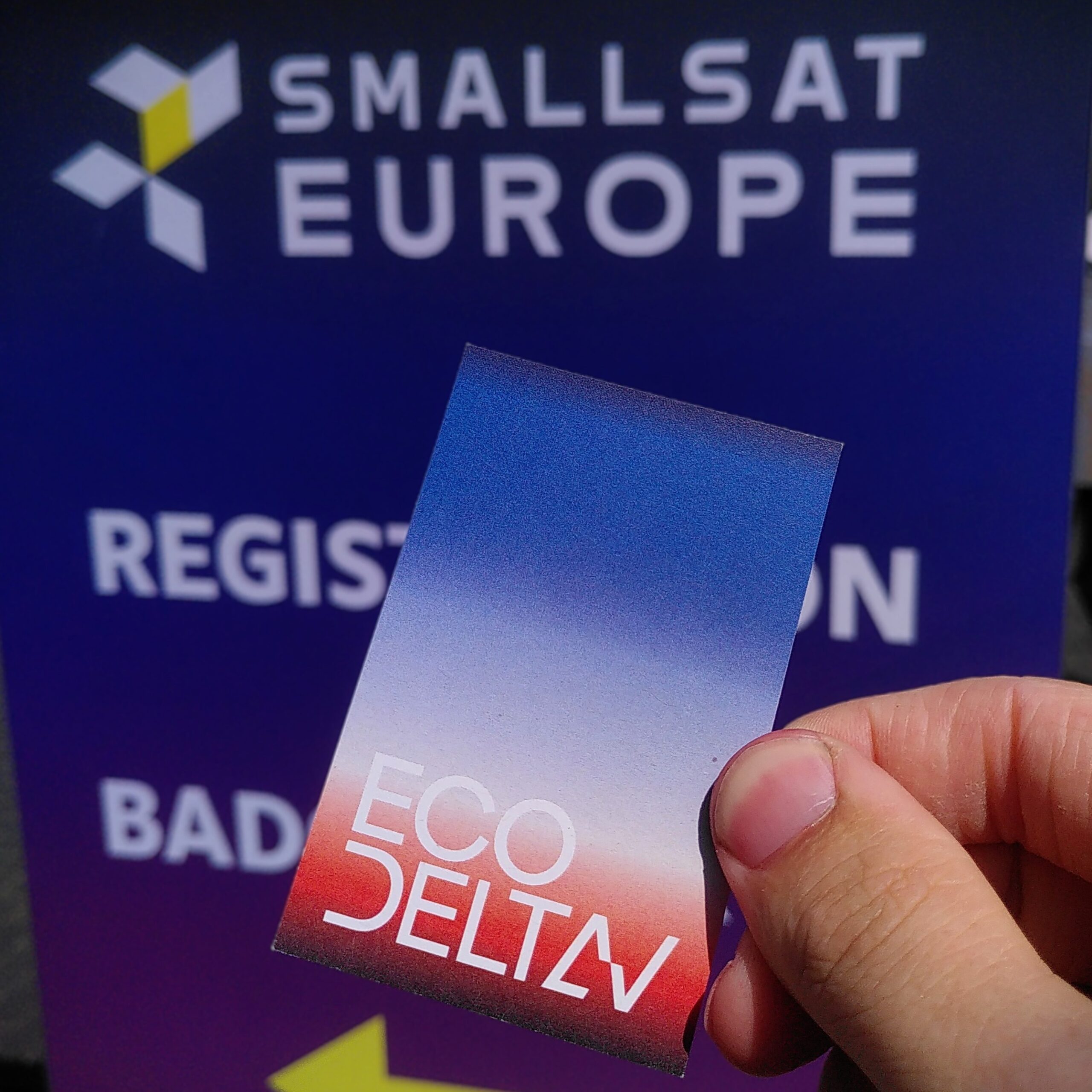

Last week, EcoDeltaV attended SmallSat Europe 2026 in Amsterdam. As a spin-off from EPFL and the University of Stuttgart, fresh from completing a major ESA project, the objective was clear: to stress-test the company’s business model against the reality of the commercial space market.
Marnix Verkammen, co-founder, spoke with tens of CEOs, lead engineers, PR managers, and sales representatives. The conversations were candid, critical, and incredibly revealing.
If there is one overarching takeaway from the conference, it is this: For commercial space companies, sustainability is not (yet) a voluntary ethical choice; it is a calculation of risk, compliance, and capital.
Here are the five key lessons learned, and how they are shaping the roadmap for the Assessment and Comparison Tool (ACT).
1. The “Voluntary” Gap is Real
Let’s be honest: for the vast majority of the commercial players spoken to, conducting a full Life Cycle Assessment (LCA) of their mission’s environmental impact on Earth is not yet a priority. When faced with the choice between optimising payload mass or calculating the environmental footprint of a launch, the business case for the latter often feels abstract.
Unlike the few pioneers who have sustainability in their company’s DNA and the companies bound by strict institutional contracts (e.g. with ESA or CNES), many commercial entities view Earth-impact assessment as a “nice-to-have” rather than a “must-have.”
The Reality Check: This mindset is about to become a liability as regulations tighten.
2. The EU Space Act is the Catalyst
The shadow of the EU Space Act loomed over every hallway conversation. With the regulation expected to take effect around 2030, the message from the Business Stage panels was clear: sustainability is becoming a necessary cost of doing business in Europe.
The EU Space Act’s sustainability pillar will require operators to assess and reduce their environmental impact. While the assessment’s required depth and details are still being refined, the direction of travel is undeniable. Companies that wait for the final text to be published will be scrambling to catch up. Those who start measuring today will be compliant by default.
EcoDeltaV’s Takeaway: ACT is not just a tool for “green” companies; it is an insurance policy for regulatory compliance. The tool is being built to help space companies navigate this ambiguity before it becomes a mandate.
3. Space Debris is the Immediate Pain Point
While Earth-bound impact assessments (e.g. through LCA) is seen as a future regulatory burden, in-space sustainability is an immediate operational concern.
Almost every company spoken to identified space debris as a critical risk. Concerns about collision risks, design-for-demise compliance, and the longevity of constellations were universal. Interestingly, many equate “sustainability” almost exclusively with “debris mitigation.”
The Focus: This feedback is invaluable. It confirms that users need a stronger focus on orbital impact. Consequently, EcoDeltaV is committing to enhancing the space debris capabilities within ACT. This includes the further refinement of the currently deployed Space Debris Index calculator, providing a single, clear metric to assess the orbital sustainability of a mission alongside its environmental footprint. The goal is to ensure this critical aspect is as robust and accessible as the LCA module.
4. Sustainability is a Currency for Investors and Institutional Players
A surprising insight emerged from conversations with CEOs and Sales Directors: sustainability data is becoming a commercial asset.
Several companies noted that having robust environmental data helps them:
- Secure funding: Investors are increasingly demanding ESG (Environmental, Social, and Governance) compliance as part of their due diligence.
- Win contracts: Institutional players are starting to require sustainability assessments in their tender processes.
For these companies, ACT is not just about compliance; it’s about competitiveness.
ACT’s value: It allows them to prove to their stakeholders that their mission is future-proof and financially sound.
5. The Need for Simplification
Finally, a recurring theme: the current methods for LCA and debris analysis are too complex, too slow, and too academic for the fast-paced environment of modern space companies. Engineers do not need a PhD in environmental science to fly a satellite; they need a tool that fits into their workflow.
This validates EcoDeltaV’s core mission: ACT is designed to be the bridge between rigorous ESA-grade methodology and the practical needs of a lean team. The tool simplifies the process so engineers can focus on design.
What’s Next?
The feedback from SmallSat Europe has directly influenced the company’s roadmap.
- For the LCA skeptics: EcoDeltaV is doubling down on making Earth-impact assessment effortless, preparing clients for the 2030 EU Space Act deadline.
- For the debris-focused: The team is looking into significant improvements to the debris risk metrics within ACT, responding directly to market demand for better orbital risk tools.
- For everyone: The Early Adopter Program will launch officially at Clean Space Days 2026 (June 29–July 3).
EcoDeltaV is inviting a limited number of companies to join as founding members. Participants will get discounted access to ACT, direct input on the improvements of the tool, and a direct line to EcoDeltaV’s team (Marnix Verkammen, Mathieu Udriot, and Jan-Steffen Fischer).
The industry is changing. The regulations are coming. The question is: will you be ready?
If you are interested in shaping the future of space sustainability tools, contact us at info@ecodeltav.com or visit the EcoDeltaV team at Clean Space Days in ESTEC at the end of June.