

The space industry is facing a paradox. As launch frequency accelerates to meet the demands of New Space, our ability to accurately measure the environmental impact of these missions—specifically in the upper atmosphere—remains surprisingly limited. Current Life Cycle Assessments (LCAs) often rely on broad estimates rather than precise data when calculating the effects of high-altitude emissions.
EcoDeltaV is proud to announce it has been selected as Prime Contractor by the European Space Agency (ESA) to lead a groundbreaking new research initiative dedicated to solving this critical knowledge gap. This consortium brings together a powerhouse of European experts to transform how the industry understands, models, and mitigates the atmospheric impact of rocket launches. The project officially kicked off in July 2026 and will run for one year, delivering crucial insights just as the sector faces increasing pressure to validate its environmental claims with robust data.
The Challenge: Why High-Altitude Emissions Remain a Mystery
To design truly sustainable space missions, engineers must understand the full lifecycle of a launch. While ground-level emissions are relatively well-understood, the physics and chemistry of rocket plumes at altitudes between 50km and 120km (the stratosphere and mesosphere) are complex and difficult to observe.
At these heights, emissions interact with the atmosphere in unique ways that create significant modeling challenges:
- Complex Chemistry: The interaction of water vapour, soot, and alumina particles with sparse atmospheric molecules creates chemical reactions that are hard to model without direct empirical data.
- Data Scarcity: Direct measurement campaigns are rare, expensive, and technically challenging, leaving significant gaps in current scientific models.
- The LCA Blind Spot: Without robust data, environmental impact assessments for satellites and launchers often rely on assumptions. This uncertainty makes it difficult for space companies to make informed ecodesign choices or to validate their sustainability claims with confidence.
This project fits directly into the European roadmap for space sustainability, devised by the ESA CleanSpace and AI teams, which prioritises the transition from estimation to evidence-based metrics. By strengthening fundamental knowledge of the upper atmosphere, this research ensures that future sustainability policies and engineering decisions are built on robust physics.
The Consortium: A Triad of Expertise
Tackling a challenge of this magnitude requires a multidisciplinary approach. The consortium combines three distinct pillars of expertise: atmospheric science, advanced software engineering, and space lifecycle assessment.
1. The Science: DLR Institute of Atmospheric Physics
The foundation of this project is high-quality empirical data. Our partner, the German Aerospace Center (DLR), specifically its Institute of Atmospheric Physics, brings decades of experience investigating the physics and chemistry of the global atmosphere up to 120km. Crucially, the project will leverage where possible the data from DLR’s ongoing measurement campaign, FIREWALL. This campaign provides rare, direct observations of high-altitude launch plumes, serving as the “ground truth” needed to validate new atmospheric models.
2. The Engine: Ateleris GmbH
Turning sparse physical data into a usable global model requires advanced computational power. Ateleris, a Swiss software and data engineering company, leads the development of the machine learning (ML) frameworks for this initiative. Ateleris specialises in the full software lifecycle for space missions, from onboard systems to ground data pipelines. In this project, they are applying their expertise in machine learning and optimisation to create surrogate models. These AI-driven models will interpolate the limited data from DLR and literature to simulate emission impacts across different launch types, trajectories, and atmospheric conditions, effectively “filling in the blanks” of our current knowledge.
3. The Prime: EcoDeltaV
As the Prime Contractor, EcoDeltaV coordinates the consortium and ensures the scientific outputs are translated into practical tools for the industry. Founded as a spinoff from EPFL and the University of Stuttgart following a successful ESA project, EcoDeltaV specialises in space sustainability, ecodesign, and Life Cycle Assessment (LCA). Our team brings proven expertise in developing environmental impact assessment tools, including the Assessment and Comparison Tool (ACT) and the Launch Emissions Calculation Tool. Our role is to bridge the gap between fundamental research and industrial application, ensuring that the new physical models developed can eventually inform the next generation of LCA standards.
Moving from estimation to precise measurement is the next frontier for space sustainability. This project allows us to ground our tools in real-world physics, providing the industry with the confidence to make truly data-driven ecodesign decisions.
— Mathieu Udriot, Project Lead and Head of Technology at EcoDeltaV.
From Data to Precision: The Methodology
The project’s internal codename serves as a deliberate nod to our partner’s FIREWALL campaign which captures the raw “heat” of emission data. EXTINGUISHER is designed to process that data to simulate impacts and “douse” the uncertainties that currently plague atmospheric models. By employing a machine learning surrogate modeling approach, the consortium transforms complex atmospheric physics into rapid, industry-ready software.
The planned workflow aims to follow four key stages:
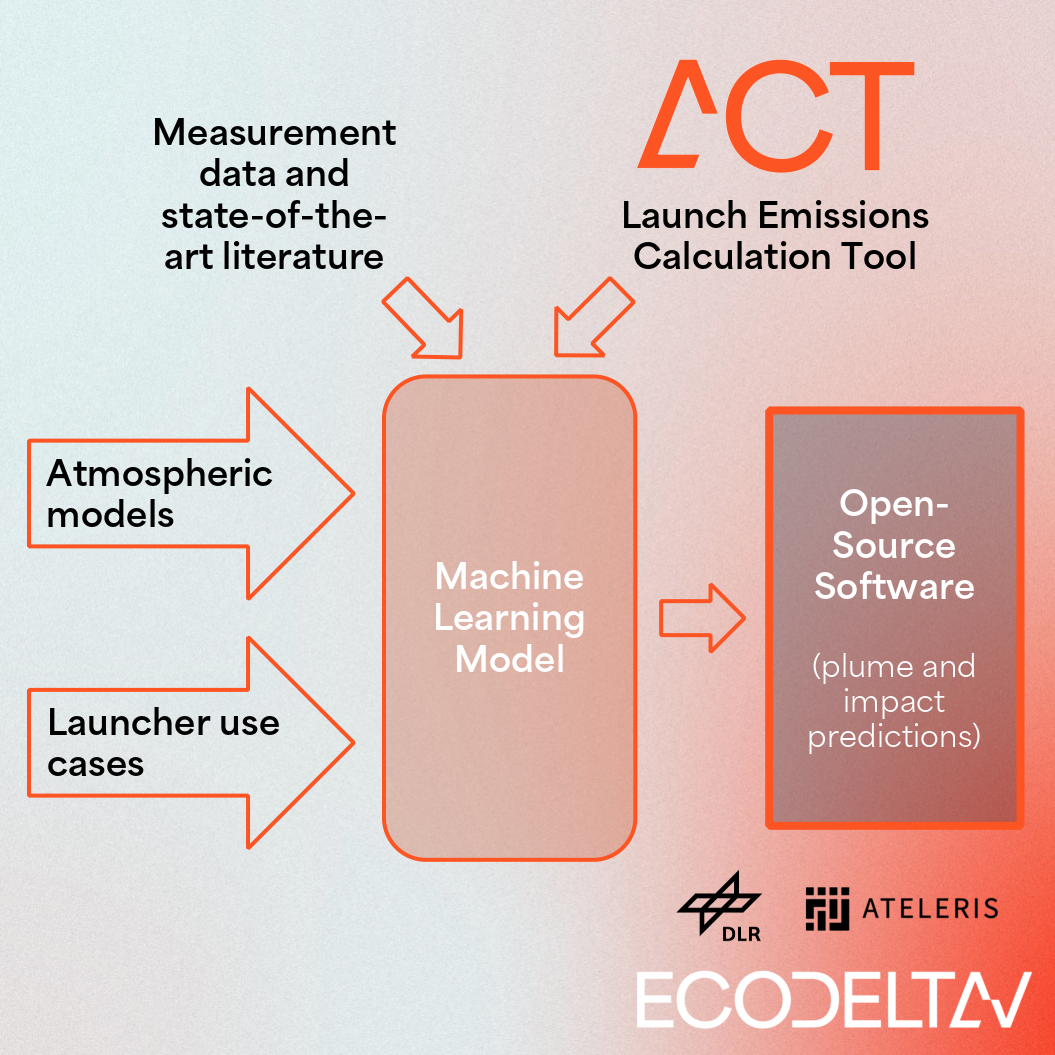
- Multi-source data ingestion: The model aggregates launcher parameters, state-of-the-art chemistry transport models (CTM), and measurement data from FIREWALL and literature. These are trained against baseline estimates from ACT’s Launch Emissions Calculation Tool (LECT) and global literature on rocket emissions and re-entry impacts.
- AI-driven modeling: Ateleris develops algorithms to learn non-linear relationships between launch profiles and atmospheric responses, creating a surrogate model that predicts outcomes without slow, traditional physics simulations.
- Prediction of key LCA indicators: The software delivers precise, time-dependent calculations for critical impact categories: Radiative Forcing (RF) and Ozone Depletion Potential (ODP).
- Rigorous validation: A dual-layer check ensures accuracy: Ateleris validates statistical robustness, while EcoDeltaV verifies physical plausibility against known chemical reactions.
The final deliverable is a standalone software tool that converts months of complex modeling into instant, scientifically validated estimates for ecodesign.
A Commitment to Open Innovation
Sustainability challenges are too large for any single company to solve alone. To maximise the impact of this research, the software outcomes of the project will be released as Open Source under the ESA Software Community License.
By making these models and tools available to the wider scientific and industrial community, we aim to:
- Accelerate the adoption of accurate emission models across the European space sector.
- Enable researchers worldwide to build upon these findings without reinventing the wheel.
- Foster a collaborative environment where transparency drives innovation.
We believe that open data is the catalyst for a truly sustainable space industry. When everyone works from the same validated scientific baseline, the entire sector moves faster towards its environmental goals.
The Path Forward
This project marks a significant step in the maturity of space sustainability. By combining direct measurement, artificial intelligence, and lifecycle expertise, we are moving towards a future where the environmental impact of every launch is known, understood, and optimised.
For companies in the space sector, this means future LCAs will be more accurate, regulations will be more grounded in reality, and ecodesign choices will be more effective.
We are honoured to lead this effort alongside our partners @DLR and @Ateleris, and we look forward to sharing our findings with the community as the project progresses over the coming year.
About the Consortium:
- EcoDeltaV: A Swiss spinoff specialising in space sustainability, ecodesign, and Life Cycle Assessment (LCA). Creator of the ACT platform.
- Ateleris GmbH: A Swiss software engineering firm specialising in data pipelines, machine learning, and software for the space industry.
- DLR (Institute of Atmospheric Physics): A leading German research centre investigating atmospheric physics and chemistry up to the mesosphere.
This project is funded by the European Space Agency (ESA).